A single wedding booking is often worth ₹1–3 lakh. A pre-wedding shoot, ₹30,000–60,000. Even a birthday or maternity shoot can be ₹15,000–25,000. Now think about how many enquiries you received last season that simply... faded. Nobody said no. You just never heard back, or you never wrote back, and by the time you remembered, they had booked someone else.
For most photographers, lost leads are the most expensive problem in the business — and the easiest to fix. You do not need more enquiries. You need to stop losing the ones you already get.
This guide is a practical system for photography leads: where they come from, what to capture, how fast to reply, what to ask, how to follow up without being pushy, and how to see every enquiry on one board. It works with a notebook if you are disciplined, and it works much better with a tool built for it like CaptureBee's lead management.
Why photography leads get lost
Enquiries rarely vanish because the couple chose a better photographer. They vanish because of what happens — or does not happen — in the first week:
- The enquiry lives only in a chat. WhatsApp and Instagram are great for talking and terrible for remembering. Forty new chats later, the enquiry is gone.
- The first reply is slow. Couples message three or four photographers at once. The first one to reply properly sets the bar.
- The reply asks nothing. "Hi, yes we are available, please share details" puts all the work back on the client.
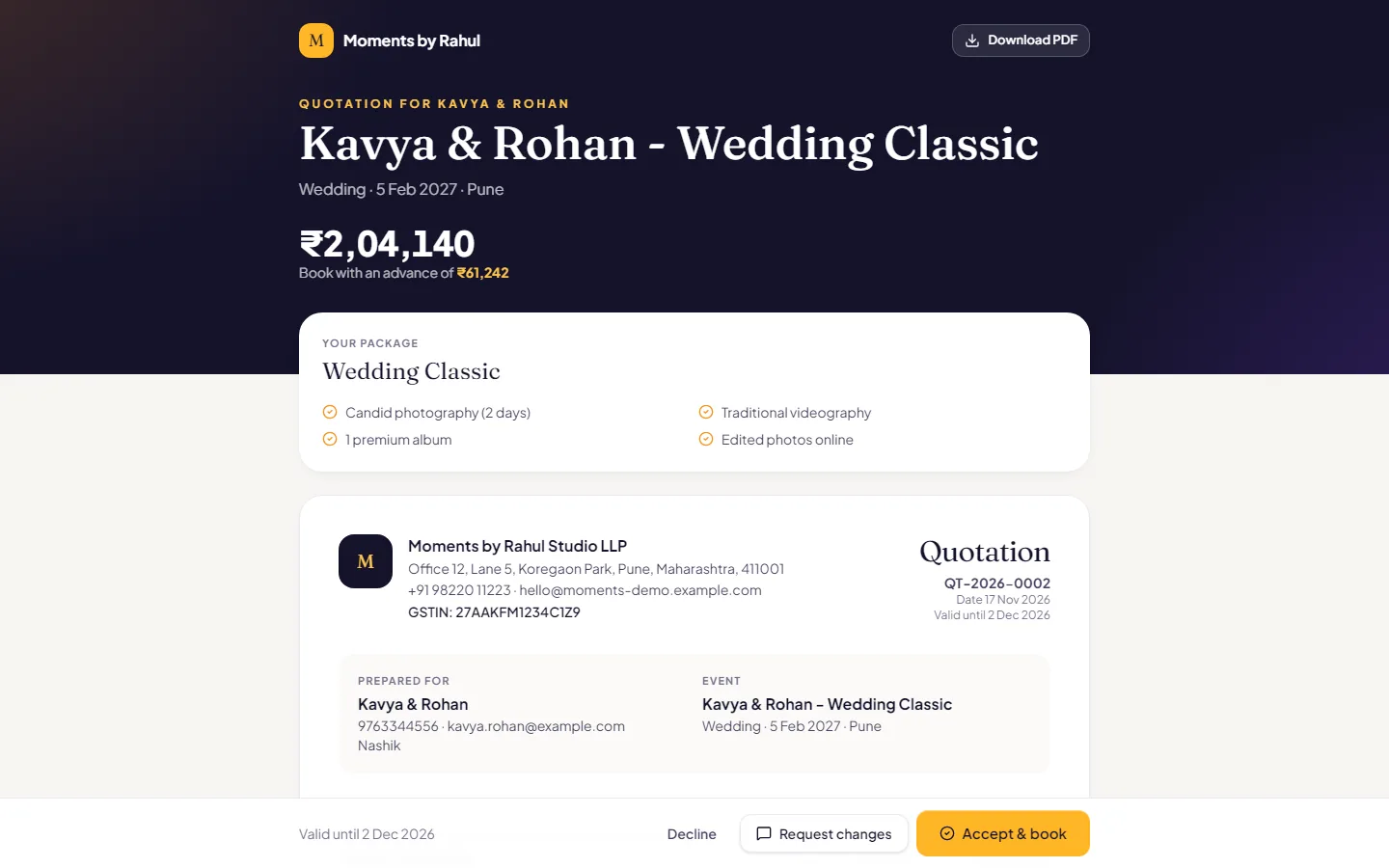
- There is no next step. After you send the quotation, nothing is scheduled. If the client goes quiet, so do you.
- Nobody owns it. In a studio, "someone" was going to call back. Nobody did.
- No one looks back. Without a list of open enquiries, you cannot even see what you are losing.
Every one of these is a process problem. Fix the process and bookings go up without spending a rupee more on marketing.
Where photography enquiries come from
Most studios get leads from six to ten places. Each behaves differently, and it is worth knowing which ones actually turn into bookings:
| Source | What it looks like | What to do differently |
|---|---|---|
| A direct message, often forwarded by a friend | Reply the same day; the conversation continues there | |
| A DM after seeing a reel or post | Move to WhatsApp or a call quickly; Instagram DMs get buried | |
| Referral | "My cousin got married last year, you shot it" | Highest intent — prioritise these |
| Website / Google | A form or a call after a search | Often comparing many studios; quote fast and clearly |
| Phone call | A call while you are shooting | Note the details immediately; call back with a plan |
| Walk-in | Someone at your studio | Capture the lead before they leave |
| Messages or comments | Usually lower intent; qualify quickly | |
| Your public profile | An enquiry form with date and package | Arrives with details already filled in |
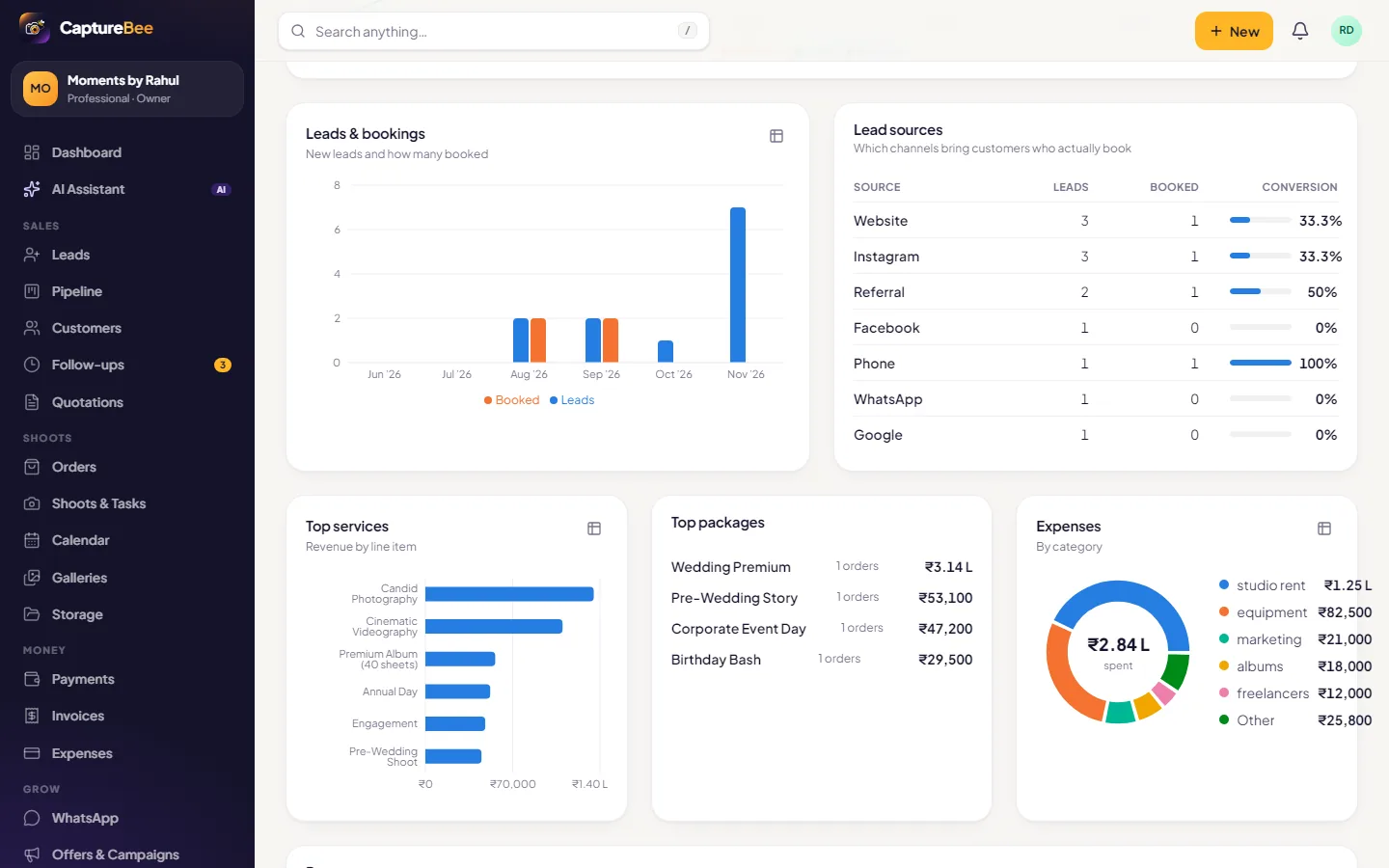
Recording the source for every lead matters more than it seems. After three months you will know, with real numbers, whether Instagram is bringing bookings or just likes — and where to spend your time and money. In CaptureBee, analytics shows leads, bookings and conversion for each source.
Rule 1: Every enquiry gets a record within the hour
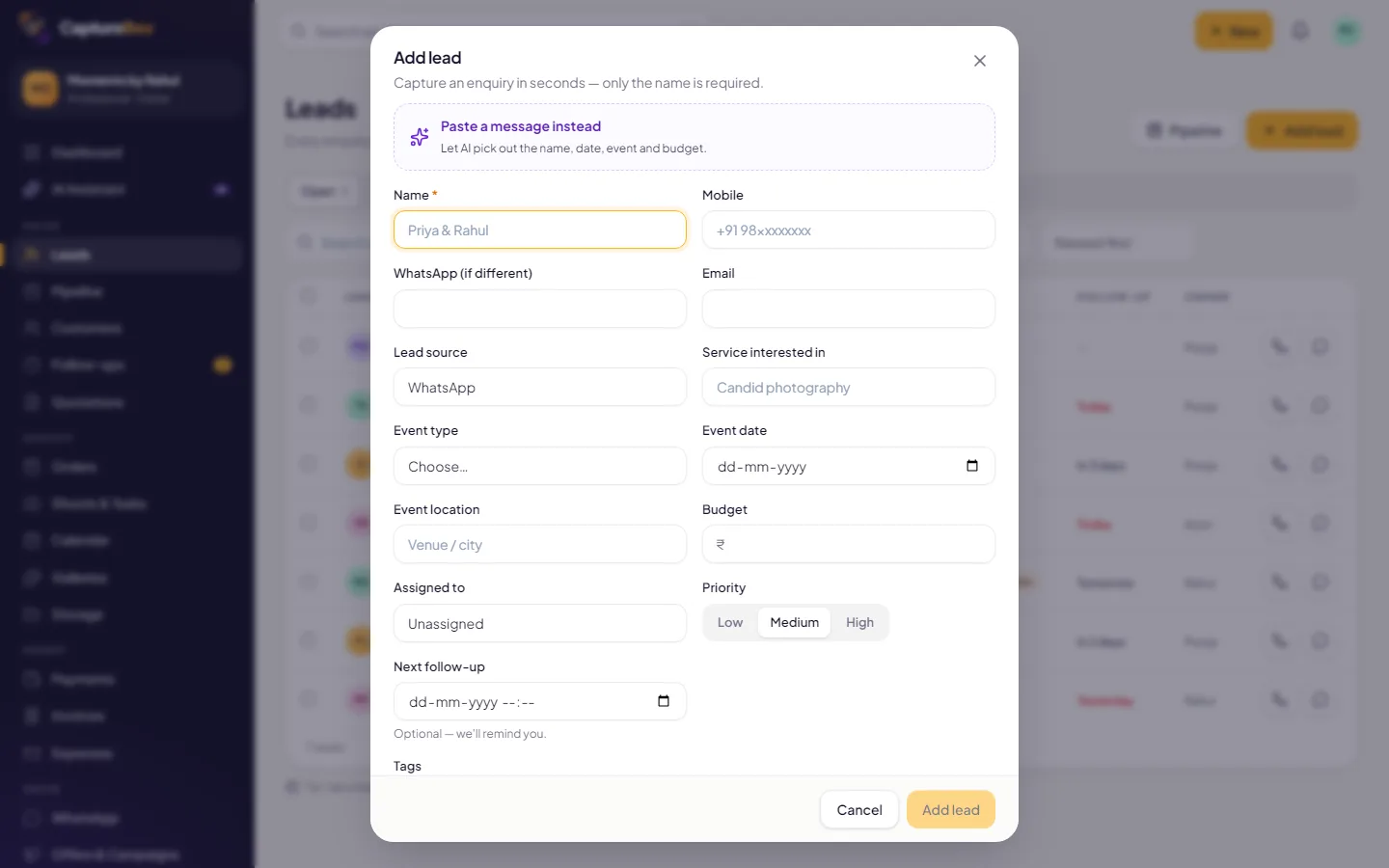
The single most important habit: when an enquiry arrives, create a lead for it — even if all you have is a name and a phone number. It takes fifteen seconds. Here is the minimum worth capturing:
- Name and mobile (and WhatsApp, if different)
- Event type — wedding, engagement, pre-wedding, birthday, maternity, corporate…
- Event date — even an approximate month helps
- Location — city or venue
- Budget — if they mention one
- Source — where they found you
- Owner — who in your team is handling it
- Next follow-up — when you will contact them next
You will not have all of it at first. That is fine. The lead exists, so it cannot be forgotten, and you fill in the rest as the conversation goes.
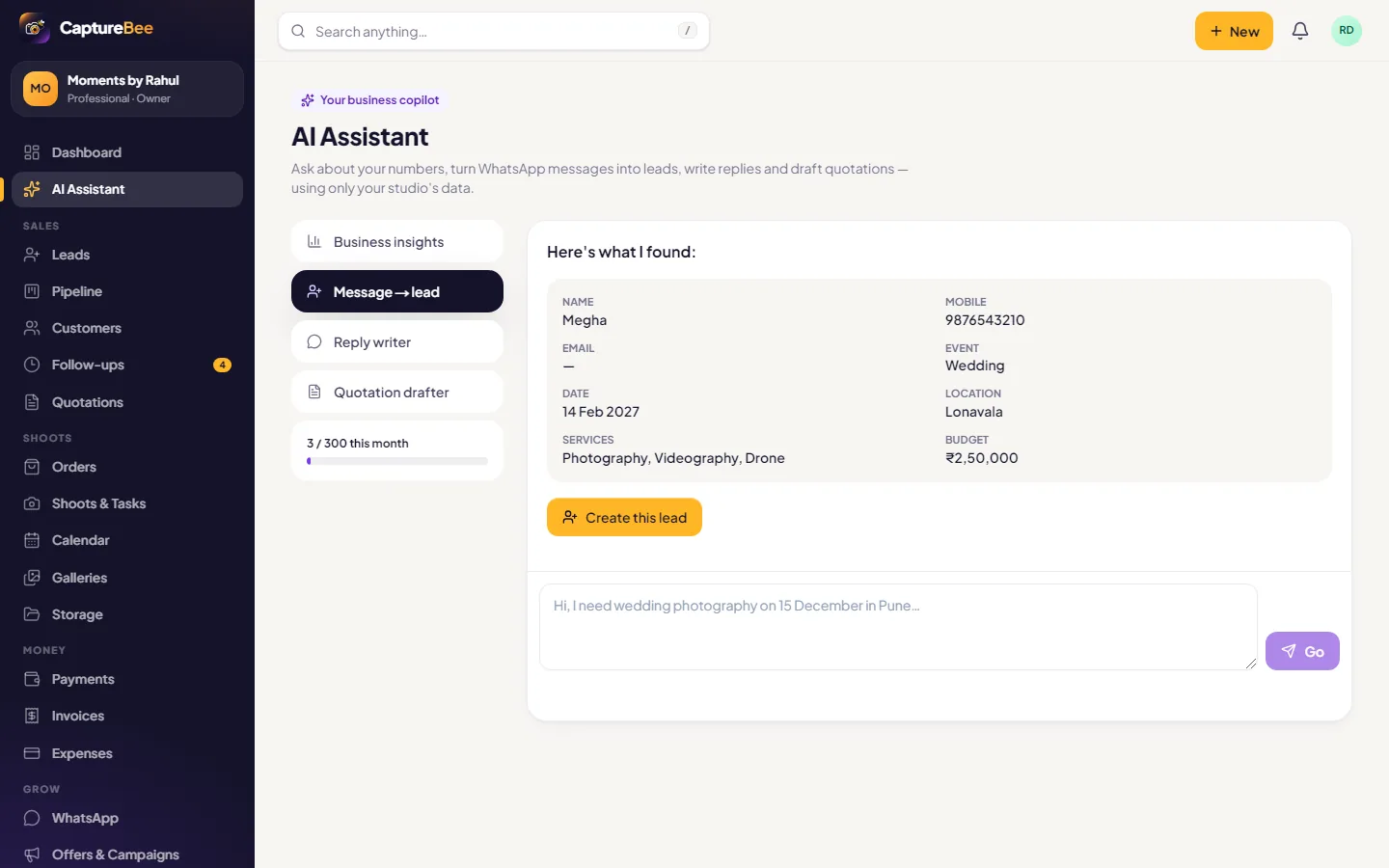
Tip: In CaptureBee you can paste the client's WhatsApp or Instagram message into Paste a message instead and the AI fills in the name, phone, event, date, location, services and budget for you. Check it, then save.
Rule 2: Reply fast, and reply with questions
Speed matters because couples are comparing. You do not need to send a quotation in the first reply — you need to show that you are responsive, interested and organised. A good first reply does three things: thanks them, shows interest in their event, and asks for exactly what you need to quote.
What to ask:
- The date (or dates) — and whether it is fixed.
- The functions — for weddings: engagement, mehendi, haldi, sangeet, wedding, reception.
- The venue or city — travel changes the price.
- What they want covered — candid, traditional, video, drone, album, pre-wedding.
- Rough guest count — it affects crew size.
- Budget range — ask gently; many clients will share it.
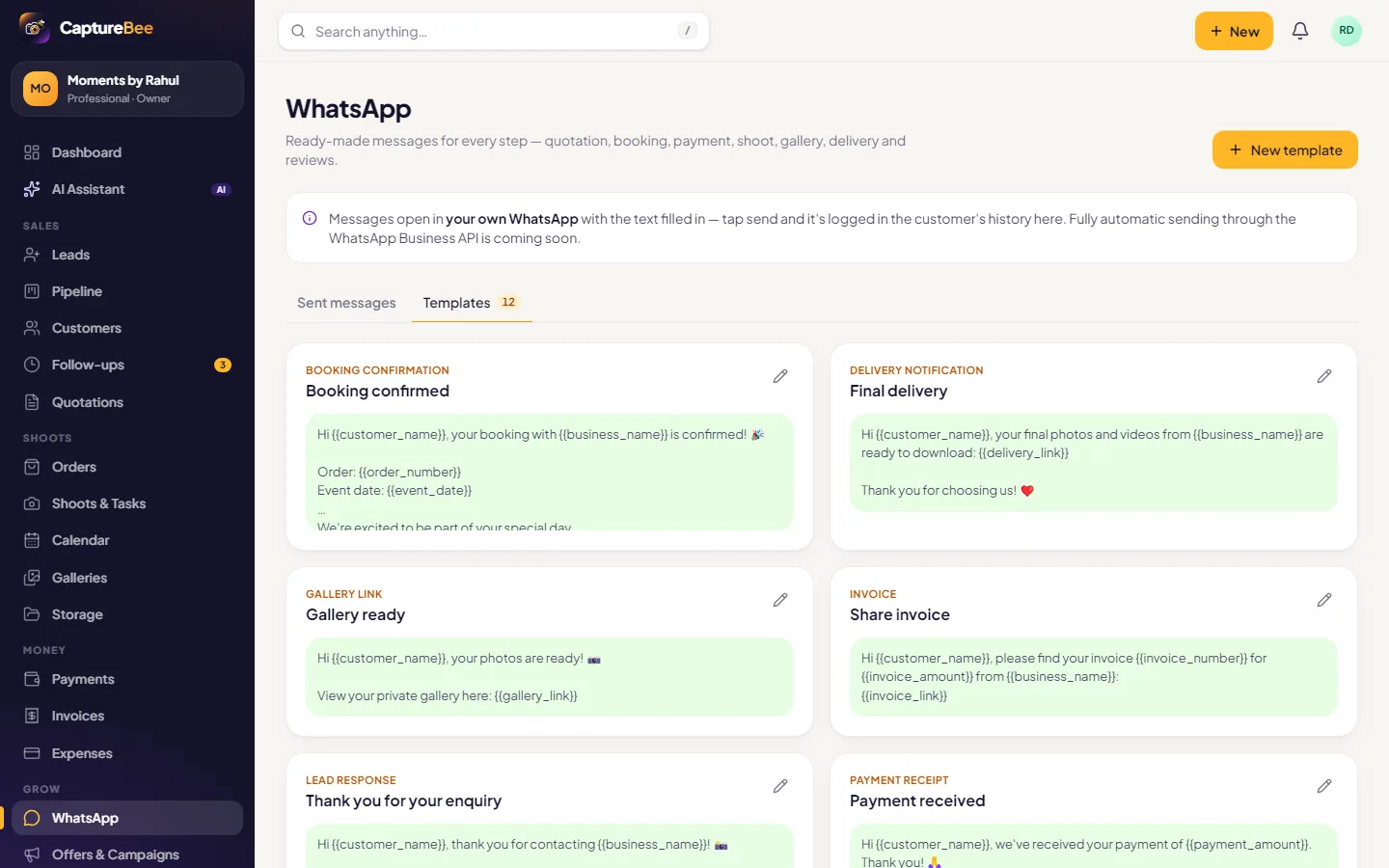
Here is the default enquiry reply in CaptureBee, which you can edit to sound like you:
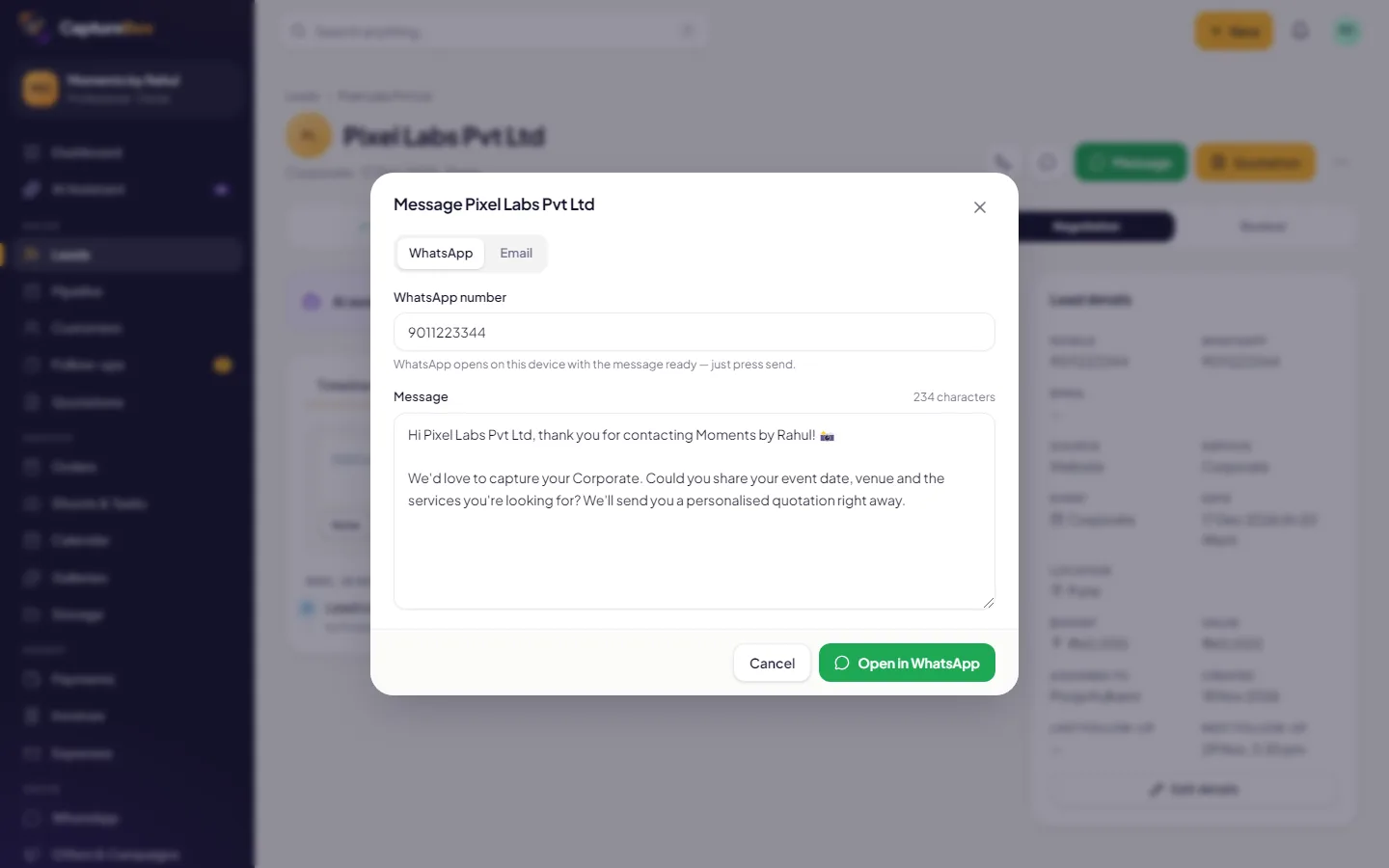
Hi {{customer_name}}, thank you for contacting {{business_name}}! We'd love to capture your {{event_type}}. Could you share your event date, venue and the services you're looking for? We'll send you a personalised quotation right away.
Press Message on the lead and it opens with the name, studio and event already filled in. Tap Open in WhatsApp and it is ready to send from your own number. The message is logged on the lead, and a lead that was New moves to Contacted automatically. More templates in WhatsApp templates for photographers.
Rule 3: Qualify before you spend hours on a quote
Not every enquiry deserves the same effort. A quick qualification saves you from spending an evening on a custom quote for a date you are already booked on, or a budget that is a quarter of your minimum.
Ask yourself four questions:
- Are we free? Check the calendar first. If the date is taken, say so kindly and offer a second team or a referral.
- Is the budget in range? If it is far below your packages, offer your smallest package rather than a discount on your best one.
- Is it work we want? A corporate conference and a destination wedding need different crews.
- How serious are they? A referral with a fixed date is hotter than an Instagram "price?" message.
Use priority (low, medium, high) and tags (destination, VIP, repeat, referral) to mark what matters, so the pipeline shows at a glance where to spend your time.
Rule 4: Use a pipeline, not a pile
A pipeline turns a pile of conversations into a set of decisions. Each stage means something specific, and each card should move forward — or out — within days, not months.
| Stage | What it means | Move it when |
|---|---|---|
| New Lead | Enquiry received, not contacted yet | You have replied |
| Contacted | You've replied and asked questions | They share details or show interest |
| Interested | They've shared date, venue and needs | You send a quotation |
| Quotation Sent | They have your quotation | They respond, negotiate or go quiet |
| Negotiation | Discussing price or scope | They accept, or you agree to part ways |
| Booked | Quotation accepted, advance due or paid | The order takes over from here |
| Lost | They chose someone else or cancelled | Record the reason |
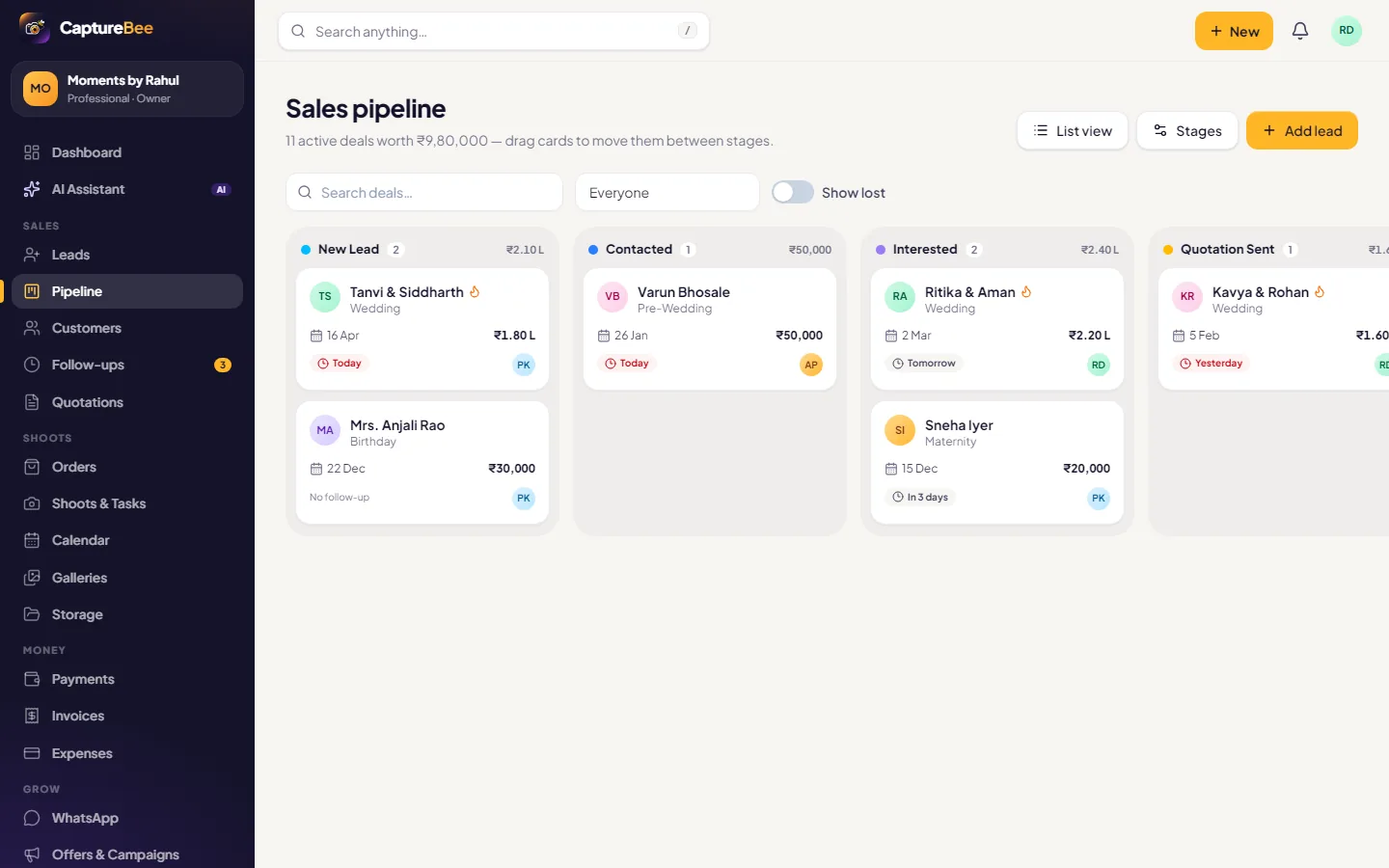
The column totals are worth watching. ₹9.8 lakh sitting in Quotation Sent is not a statistic — it is a to-do list. In CaptureBee each column shows its count and value, cards show the event, date, value and when the next follow-up is due, and you can filter by owner.
Stages are not fixed. Rename them, recolour them or add your own — "Site visit", "Call scheduled" — in Settings. See the pipeline feature.
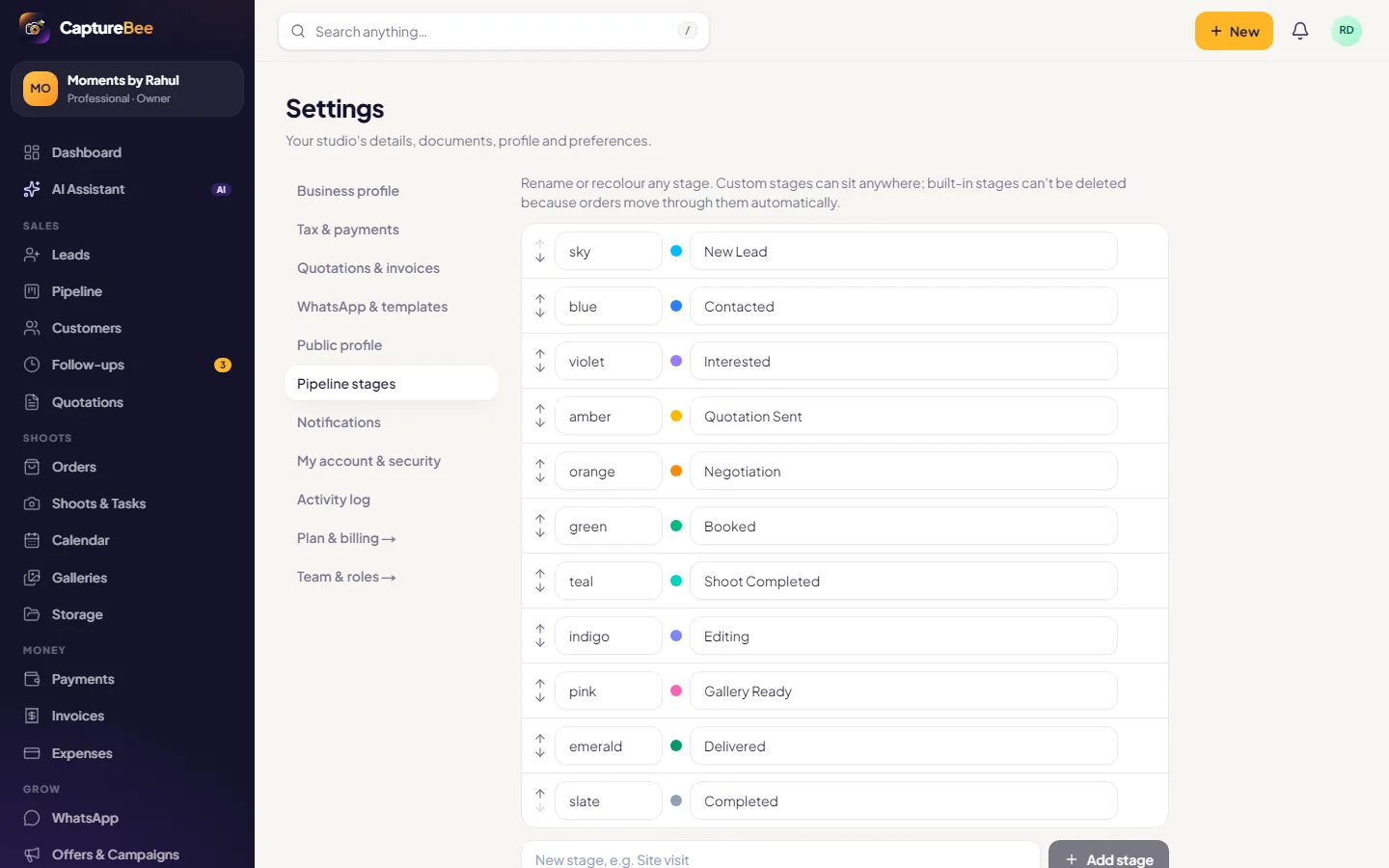
From Booked onwards, the card follows the booking automatically through shoot, editing, gallery and delivery, so the same board becomes your production tracker. More on that in the complete guide to running a photography business.
Rule 5: Follow up like a professional, not a pest
Most couples do not reply to a quotation the same day. They discuss it with family, compare it with others, check their budget. The photographer who follows up politely, at the right time, with something useful to say, wins a surprising number of those bookings.
A follow-up rhythm that works for most photographers:
| When | What to send |
|---|---|
| Day 0 | The quotation, with a short personal note |
| Day 2 | "Did you get a chance to look at it? Happy to adjust anything." |
| Day 5 | Something useful: a sample album, a similar wedding you shot, a note on the venue |
| Day 10 | A gentle check: "Dates are filling up for February — shall I hold yours?" |
| Day 21 | A final, friendly close: "If you've gone with someone else, no worries — wishing you a lovely wedding!" |
That last message often gets a reply — either "we're still deciding" or a reason you can learn from.
The Follow-ups page in CaptureBee shows what is due today, what is overdue and what is coming up. Each follow-up is linked to its lead or quotation, with call and WhatsApp buttons right there. Mark it done, log what happened and set the next one.
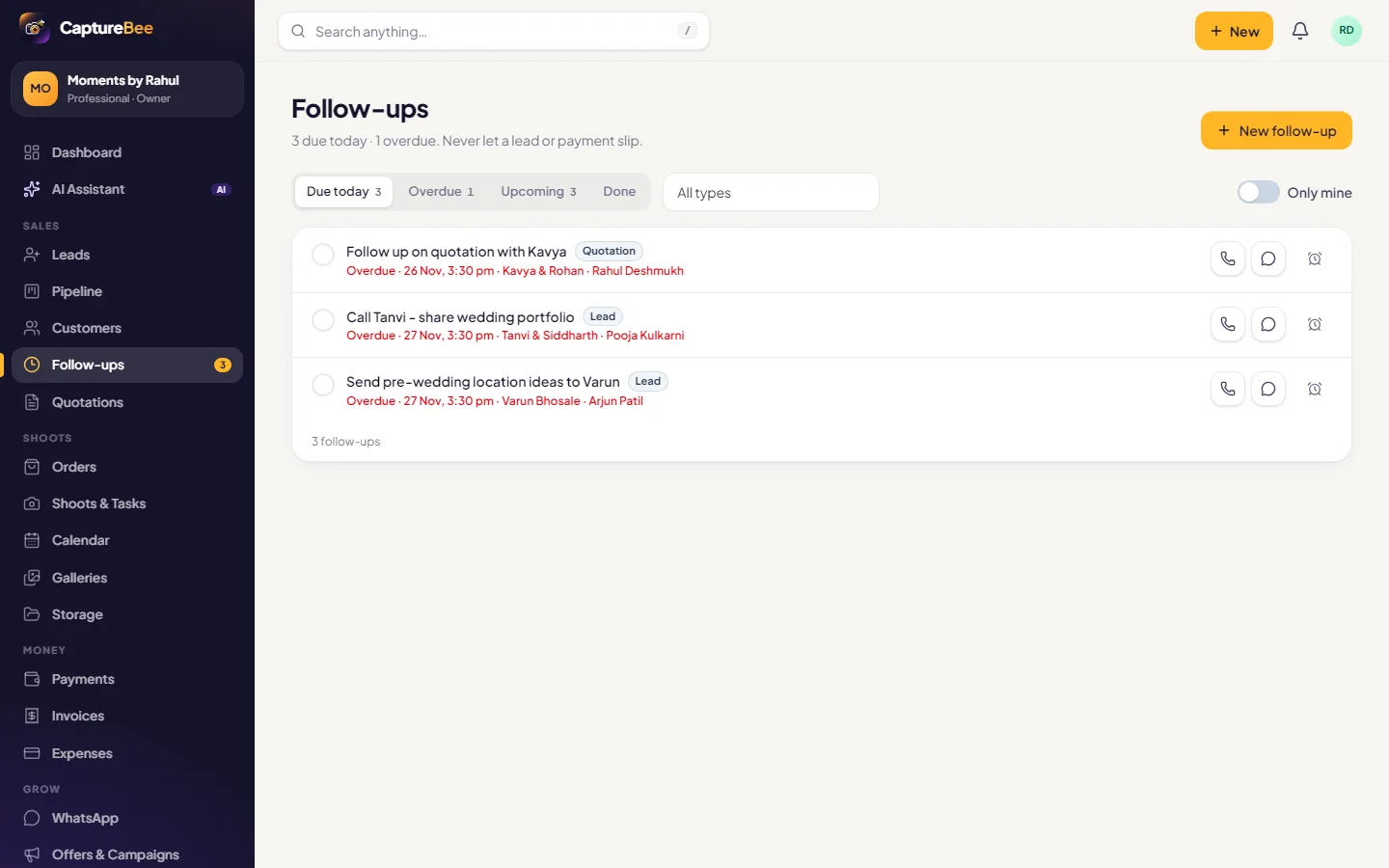
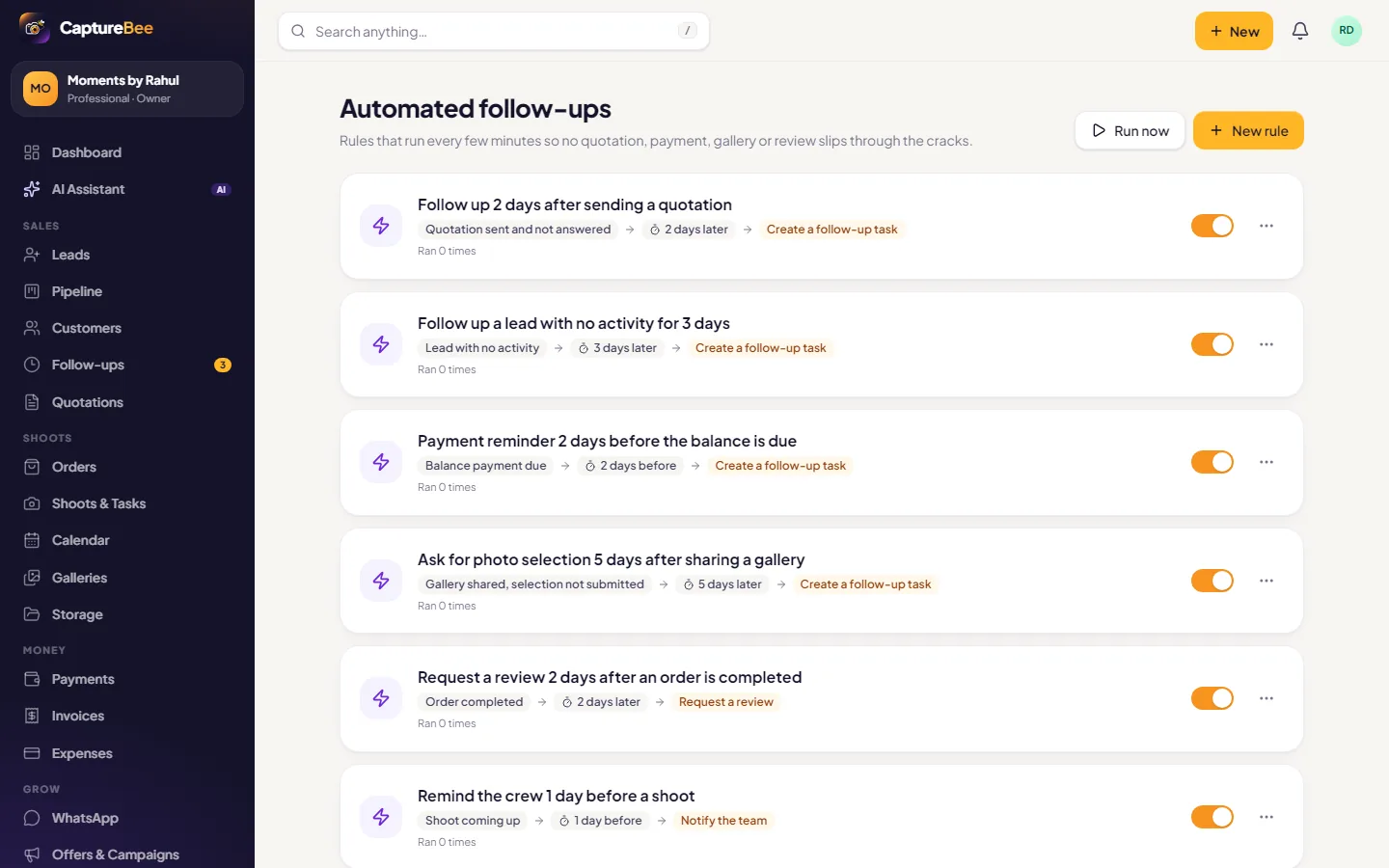
You don't even have to create most follow-ups yourself. Two of the default automations do it for you: a follow-up two days after a quotation is sent and not answered, and a follow-up when a lead has had no activity for three days.
Rule 6: Keep the whole conversation on the lead
When you or a teammate pick up a lead a week later, you should not need to scroll through WhatsApp to remember what was said. Everything belongs on the lead: notes from calls, what the client said about the venue, the quotation you sent, the messages you exchanged.
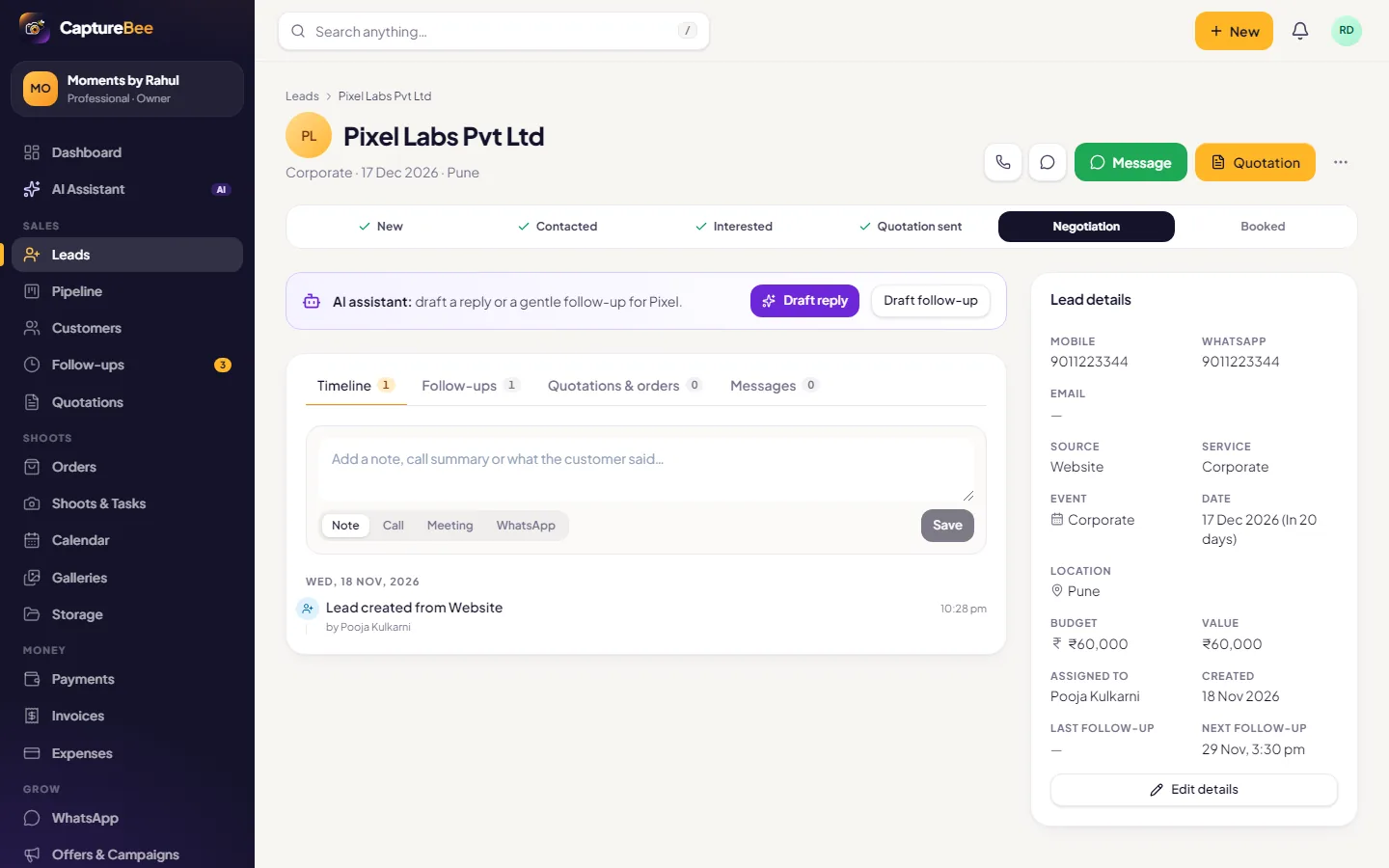
On a CaptureBee lead you will find:
- A stage tracker across the top — click to move the lead.
- A timeline of notes, calls, meetings and WhatsApp messages, with who did what and when.
- Follow-ups, quotations and orders, and messages in tabs.
- All the details: mobile, WhatsApp, email, source, service, event, date, location, budget, value, owner, created date, last and next follow-up.
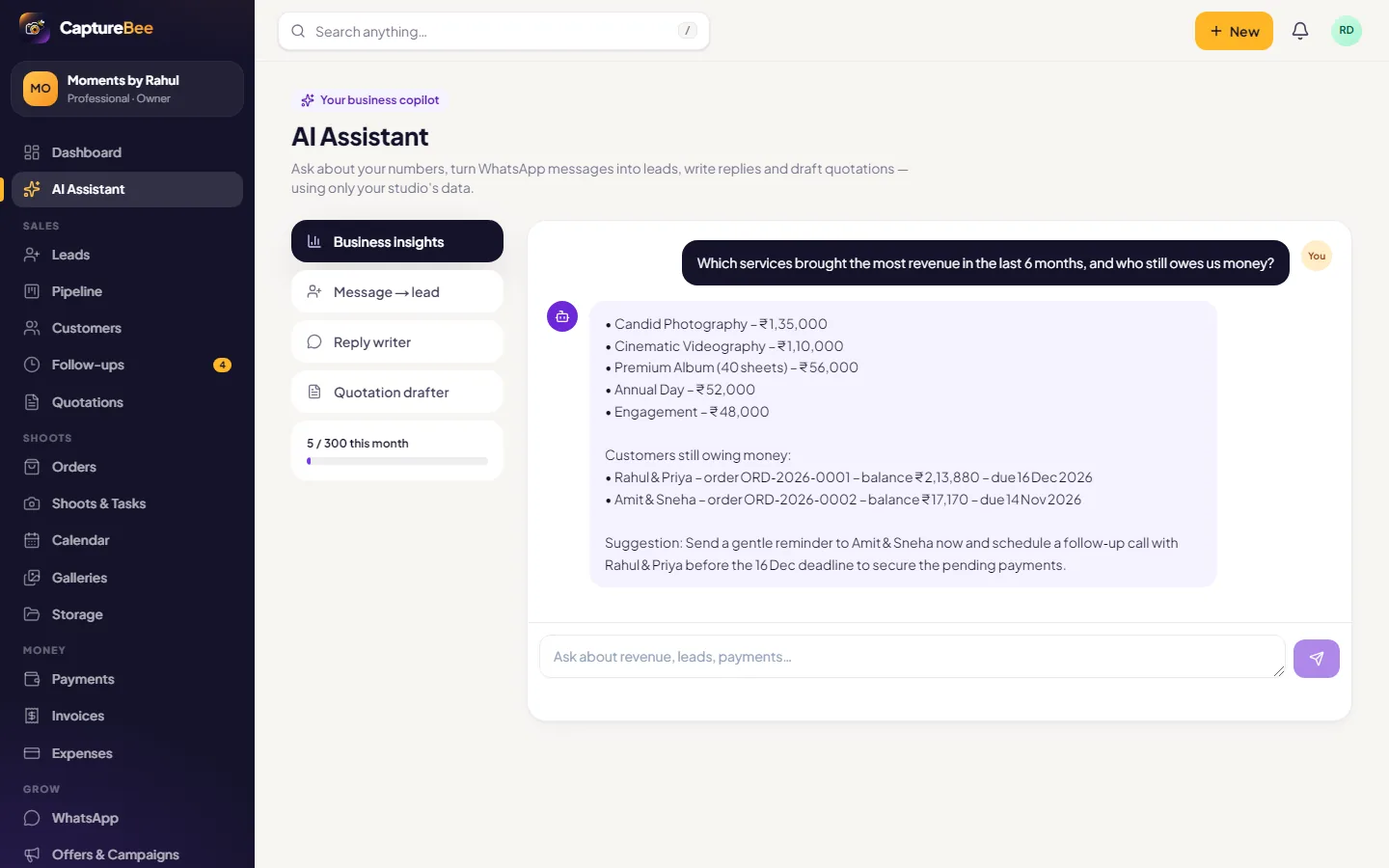
- AI suggestions to draft a reply or a gentle follow-up when you are stuck for words.
- A Quotation button that starts a quotation with the client already filled in.
When the client books, the lead becomes a customer and all of this history comes with them — no retyping, and nothing lost.
Rule 7: Learn from lost leads
You will lose leads. Everyone does. The goal is to lose them for good reasons and to learn from the rest. When you mark a lead as lost, record why:
- Budget too low
- Date not available
- Chose another photographer
- Event cancelled or postponed
- No response
After a season, the pattern is obvious. If most losses are "budget", your entry package may be too high, or you are attracting the wrong audience. If most are "no response", your follow-up needs work. If most are "date not available", it might be time for a second team.
Lost leads are not dead, either. A couple who postponed their wedding might come back next year. With CaptureBee campaigns you can send an offer to your lost leads — for example, a wedding-season discount or a free pre-wedding shoot with a full package.
Sharing leads in a team
If more than one person handles enquiries, give every lead an owner. Ownership ends the "I thought you called them" problem. In CaptureBee:
- The Assistant role can add and manage all leads, customers and follow-ups and see the calendar — ideal for someone who handles enquiries and calls.
- The Manager role runs sales and shoots: leads, quotations, orders and galleries.
- Leads can be filtered by owner, and the Only mine switch on follow-ups shows each person their own list.
- Bulk actions let you reassign or update many leads at once — useful when someone goes on leave.
More in managing a photography team.
Replies for tricky enquiries
Some enquiries are easy: a referral with a fixed date and a clear budget. Others need a little more thought. Here are the situations photographers meet most often, with replies that keep the conversation going.
"Price?"
A one-word enquiry on Instagram is common and frustrating. Don't send a full price list into the void — and don't ignore it. Give a range, show value, and ask one question:
Hi! Thanks for reaching out 😊 Our wedding coverage starts from ₹95,000 for two days of candid photography with an album, and most couples choose a package between ₹1–1.5 lakh. When is your wedding, and which functions would you like covered? I'll send you exact options.
A range qualifies them (they know roughly what you cost), and the question turns a price check into a conversation.
"What's your best price?"
This usually comes after the quotation. Resist the instant discount. Ask what matters to them, then offer options:
I completely understand — weddings have a lot of expenses! Could you tell me which parts matter most to you? If budget is the concern, we could look at the Classic package instead, or cover the reception with one photographer instead of two. That keeps the quality the same and brings the total down.
If you do offer a discount, make it specific and time-bound — "₹10,000 off if we confirm with the advance this week" — not open-ended.
The date is already booked
Never just say no. Offer what you can:
Thank you so much for thinking of us! Unfortunately we're already booked on 14 February. We do have a second team led by Arjun, who has shot with us for four years — I can share his recent work. Or, if you have any flexibility on the reception date, we're free on the 15th.
If you have no second team, recommend a photographer you trust. It costs nothing, the couple remembers it, and good photographers return the favour.
Destination or out-station weddings
Ask about travel early so the quotation isn't a surprise:
A Goa wedding — lovely! For destination weddings we quote the coverage as usual, and travel and stay for the team are charged at actuals (or arranged by the family). How many functions are there, and will the team be staying at the venue?
Put "travel and stay outside the city are charged at actuals" in your standard terms so it's on every quotation.
Budget far below your packages
Be kind and honest. Offer your smallest option, or a referral:
Thank you for sharing your budget, that really helps. Our smallest wedding package is ₹65,000 for one day with one photographer and online delivery. If that doesn't fit, I'd be happy to recommend a couple of talented photographers who work in your range.
A polite "this may not be the right fit" saves you hours and leaves a good impression — people talk.
"We'll get back to you"
This often means "we're comparing". Agree, and give them a reason to come back to you:
Of course, take your time! Just so you know, we only take two weddings a day in February, and the 5th already has one booking. If you'd like me to hold the date for a few days while you decide, just let me know.
Then set a follow-up for three days later.
The enquiry from a parent
Many wedding enquiries come from a parent, not the couple. Find out early who decides and who is the day-to-day contact, and add both to the lead's notes. Send the quotation to both if needed — an online quotation link is easy to forward.
Tags and priorities that actually help
Tags and priority are only useful if you use them consistently. A small, fixed set works better than inventing tags as you go.
Priority:
| Priority | Use it for |
|---|---|
| High | Referrals, fixed dates in peak season, budgets that match your premium packages |
| Medium | Most normal enquiries |
| Low | Price-only enquiries, far-future dates, budgets well below your range |
Useful tags:
- Referral — so you can thank the person who referred them
- Destination — needs travel planning
- VIP / repeat — past clients or important families
- Corporate — different process and payment terms
- Parent contact — the enquiry came from a parent
- Season name — e.g. "Winter 2026" — to see how a season's enquiries performed
Tags carry over when a lead becomes a customer, and you can later send a campaign to everyone with a tag — for example, an anniversary offer to every repeat client. See offers and campaigns.
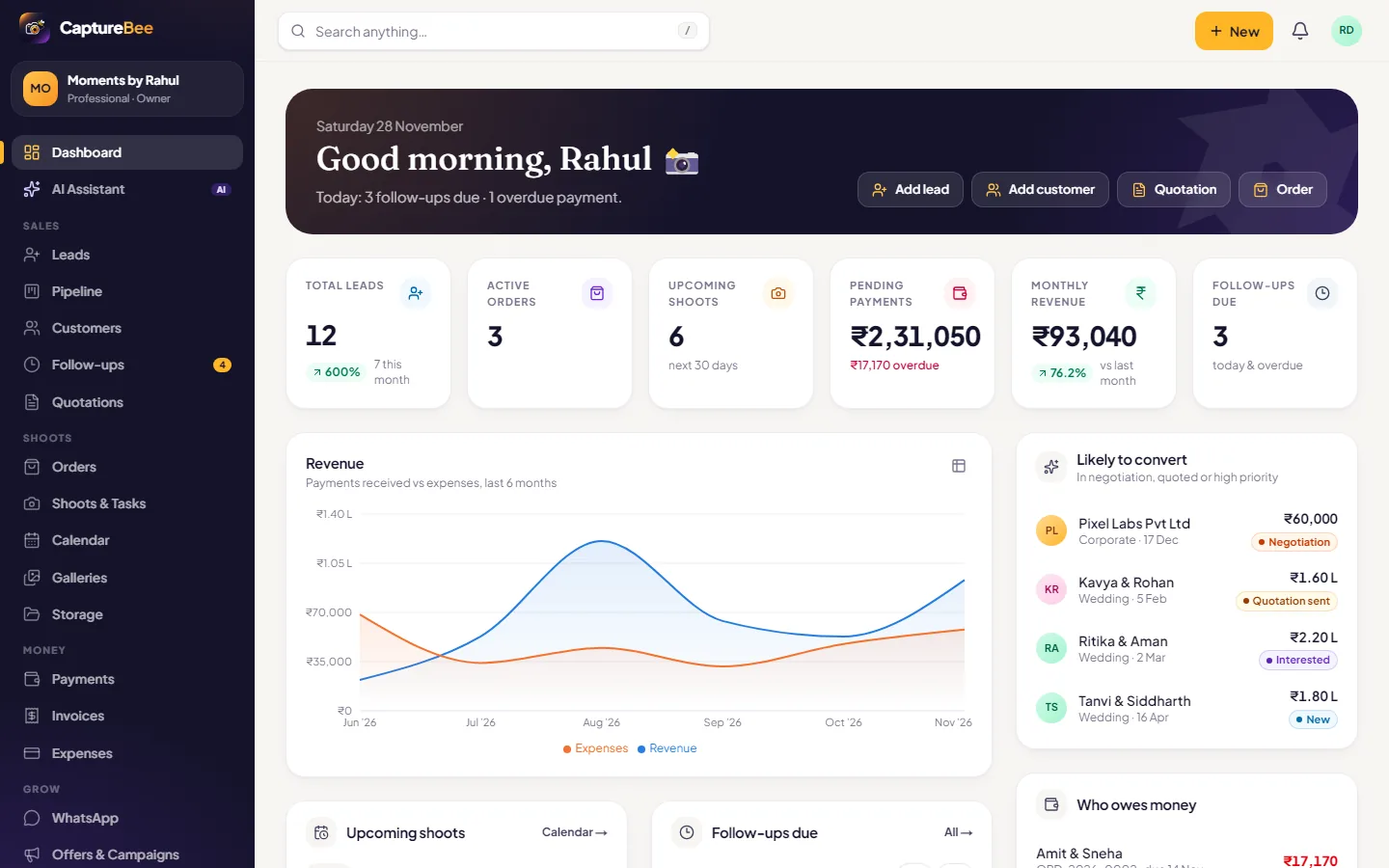
The dashboard's Likely to convert card uses the same signals — leads in negotiation, with a quotation sent, or marked high priority — to show you where to spend the next hour.
A weekly lead routine (15 minutes)
Once a week — Monday morning works well — go through this checklist:
- Open follow-ups: clear everything overdue. Call or message, or mark the lead lost.
- New leads: anything still in New Lead gets a reply today.
- Quotation Sent: anything older than a week gets a personal follow-up.
- Negotiation: decide — offer a smaller package, hold firm, or let it go.
- Calendar check: which dates are still open in peak season? Mention them in follow-ups.
- Sources: glance at which channels brought enquiries this month.
Measuring your follow-up discipline
You can't improve what you don't look at. Three simple measures tell you how well you handle enquiries:
- First-reply time. How long between the enquiry arriving and your first proper reply? Each lead's timeline shows when it was created and when it was first contacted. Aim for the same day, every time.
- Overdue follow-ups. How many follow-ups are past their date right now? A few is normal; a long list means leads are going cold while they wait.
- Leads without a next step. Any open lead with no next follow-up date is a lead you're relying on memory for. Filter for them weekly and give each a date — or mark it lost.
Track them for a month and you'll usually find one weak spot — slow first replies at weekends, or quotations that never get a second follow-up. Fix that one thing, and your conversion rate follows.
Common mistakes
- Quoting before qualifying. Ask for the date, functions and venue first; a quote without them is a guess.
- Sending only a price. "₹1.5 lakh for the wedding" invites comparison on price alone. Show what is included.
- One follow-up, then silence. Most bookings come after the second or third follow-up.
- Discounting too early. Offer a different package before you offer a discount.
- Not recording the source. Without it, you cannot tell which marketing works.
- Letting the pipeline rot. Cards that sit for months make the board useless. Move them on or mark them lost.
Frequently asked questions
How quickly should a photographer reply to an enquiry?
The same day, and ideally within an hour or two during working hours. Couples usually message several photographers at once, and the first clear, friendly reply often gets the conversation.
What should I ask a couple in the first message?
Their date, the functions they want covered, the venue or city, what they want (candid, traditional, video, drone, album), rough guest count and a budget range. That is enough to send an accurate quotation.
How many times should I follow up after sending a quotation?
Three to four times over about three weeks is reasonable: after two days, after five days with something useful, after ten days, and a friendly close after three weeks.
Can CaptureBee import my WhatsApp chats as leads?
CaptureBee does not read your WhatsApp. You add leads yourself, or paste a client's message and let the AI fill in the details. Messages you send from CaptureBee are logged on the lead automatically.
Can enquiries from my website come straight in as leads?
Enquiries from your CaptureBee public profile arrive as leads with the source set to Profile. See reviews and public profile.
What's a good conversion rate for photography leads?
It varies widely by market and price point. More useful is your own trend: track conversion by source month by month and work on the stage where most leads stall.
Start with this week's enquiries
You don't have to fix your whole sales process at once. Start with the enquiries you have right now: give each one a record, a next step and a date. Reply to anything new today. Follow up on every quotation older than two days.
If you want a system that does the remembering for you, start a free CaptureBee trial and add your open enquiries in your first ten minutes. Then read how to write quotations clients accept online — the next step for every lead you just saved.