Pricing is the question every photographer struggles with. Charge too little and you work every weekend of the wedding season for very little profit. Charge too much without showing why, and enquiries go quiet. Somewhere in between is a set of clear packages, priced from your real costs, that makes it easy for clients to choose — and easy for you to quote in a minute.
This guide walks through how to design photography packages for weddings, pre-weddings, birthdays, maternity and corporate events, how to work out prices from what a shoot actually costs you, how to build a service price list for add-ons, and how to reuse all of it in quotations and on your public profile with CaptureBee packages.
Why packages beat custom quotes every time
Custom quotes feel personal, but they slow everything down. Every enquiry becomes a small project: what to include, what to charge, how to word it. Clients find custom quotes hard to compare, and you find them hard to stay consistent with — two couples with the same needs end up with different prices.
Packages fix this:
- Faster quoting. Pick a package and the quotation is 90% done.
- Easier decisions. Couples choose between three clear options instead of negotiating line by line.
- Consistent pricing. The same work costs the same, whoever sends the quote.
- Better margins. Packages are priced deliberately, not under pressure on a call.
- Room to customise. Add or remove items for each client without starting from scratch.
How many packages should you offer?
Three to five per event type. Fewer than three gives no choice; more than five creates confusion and slows decisions.
The classic structure is good–better–best:
| Tier | Purpose | Who chooses it |
|---|---|---|
| Essential | The entry point — your minimum viable coverage | Smaller budgets, single-day events |
| Classic | Your most popular, best-value package | Most couples |
| Premium | Everything, done beautifully | Couples who want the full experience |
Most people pick the middle option, so design your middle package to be the one you most want to sell — the best balance of value for the client and margin for you. The premium package makes the middle one look reasonable; the essential one keeps smaller budgets from leaving.
What to include: example packages
Here are realistic packages for the most common events. Adjust names, inclusions and prices to your market and style.
Weddings
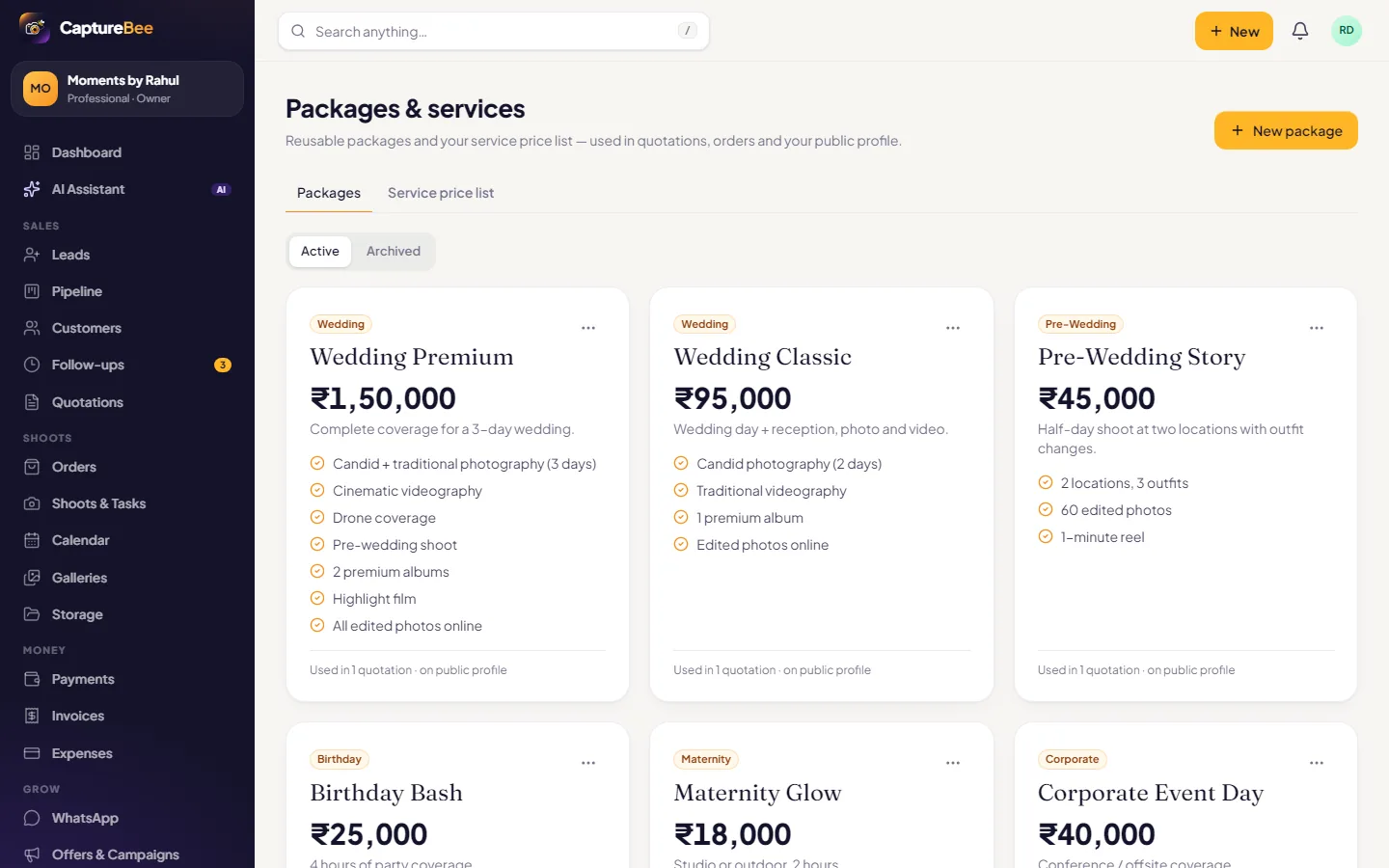
Wedding Premium — ₹1,50,000 (3-day wedding)
- Candid and traditional photography (3 days)
- Cinematic videography
- Drone coverage
- Pre-wedding shoot
- 2 premium albums
- Highlight film
- All edited photos online
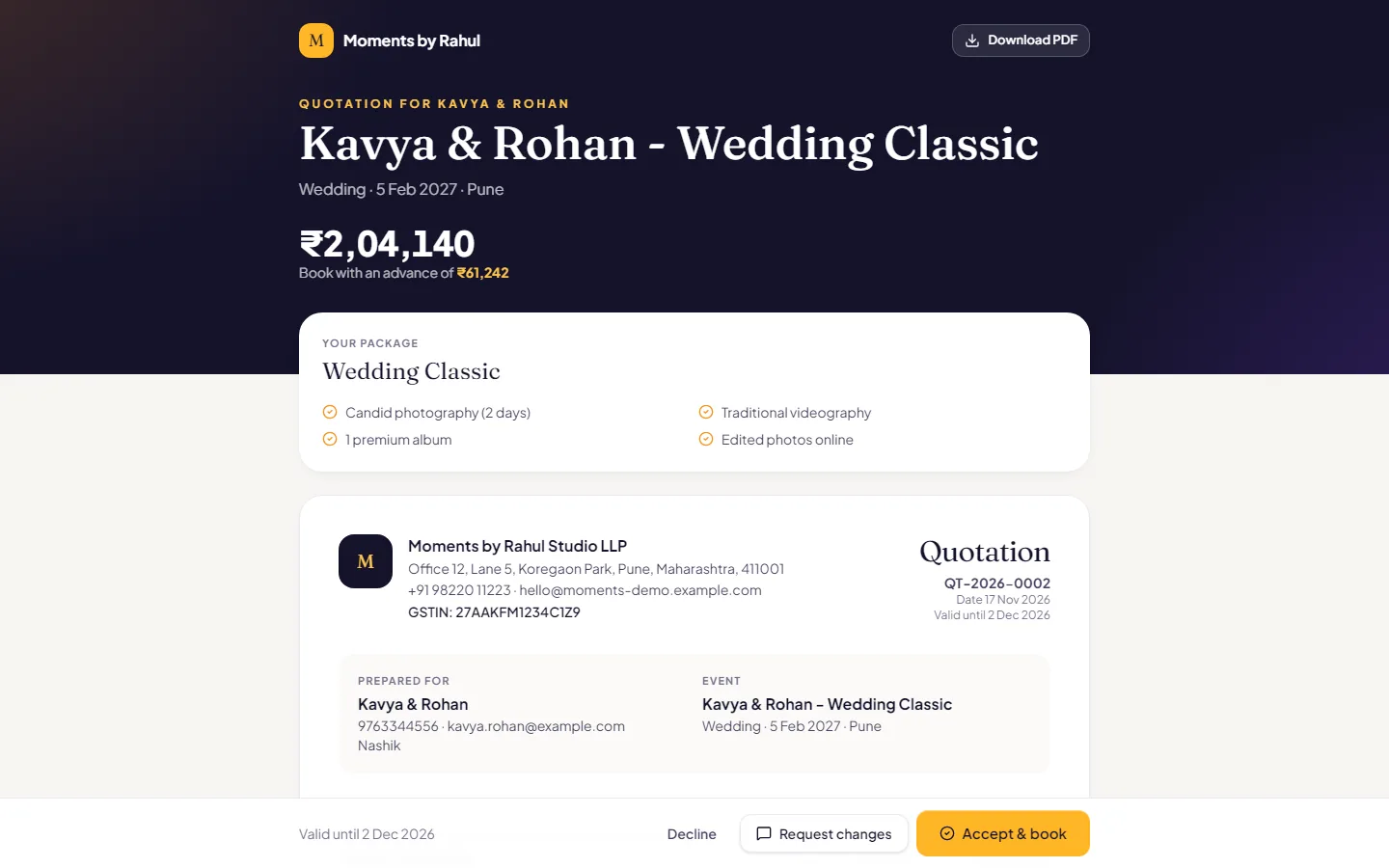
Wedding Classic — ₹95,000 (wedding day + reception)
- Candid photography (2 days)
- Traditional videography
- 1 premium album
- Edited photos online
Pre-wedding
Pre-Wedding Story — ₹45,000
- Half-day shoot at two locations with outfit changes
- 2 locations, 3 outfits
- 60 edited photos
- 1-minute reel
Family and personal
Birthday Bash — ₹25,000: 4 hours of party coverage, candid photography, 150 edited photos, online gallery.
Maternity Glow — ₹18,000: studio or outdoor, 2 hours, 2 outfits, 30 edited photos.
Corporate
Corporate Event Day — ₹40,000: event photography for 8 hours, same-day 30 highlights for social media, edited photos within 48 hours.
Tip: Write inclusions as outcomes the client understands — "60 edited photos", "1-minute reel", "album in 40 sheets" — not as your internal process. "Colour grading" means little to a couple; "a cinematic highlight film" means a lot.
Pricing from your real costs
Many photographers set prices by looking at what others charge. That tells you what the market will bear, but not whether you make money at that price. Work it out from the other direction too.
Step 1: List what a shoot actually costs you
For a two-day wedding with one extra photographer and a videographer, the direct costs might look like this:
| Cost | Example |
|---|---|
| Second photographer (2 days) | ₹16,000 |
| Videographer (2 days) | ₹20,000 |
| Editing (photos + film), if outsourced | ₹15,000 |
| Album printing | ₹9,000 |
| Local travel and food for crew | ₹6,000 |
| Direct cost | ₹66,000 |
Step 2: Add your share of fixed costs
Equipment wears out, software and cloud storage cost money every month, and marketing is not free. Add up a year of these — camera bodies and lenses spread over their life, studio rent, software, storage, Instagram ads — and divide by the number of shoots you do. If your fixed costs are ₹4,80,000 a year and you do 40 events, that is ₹12,000 per event.
Step 3: Value your own time
Count all the hours: meetings, travel, the shoot days, culling, selection, delivery. A two-day wedding can easily be 50–60 hours of your time. Decide what your hour is worth.
Step 4: Add margin, then compare with the market
Direct cost (₹66,000) + fixed share (₹12,000) + your time (say ₹30,000) = ₹1,08,000 before profit. If the market says your Classic package should be ₹95,000, you now know something important: either your costs are too high for that package, or the package includes too much, or you need to price higher and show why.
This exercise often reveals that the most popular package barely makes money. Better to know now than at the end of the season.
Note: Track real costs as they happen. In CaptureBee, record expenses by category — freelancers, travel, albums, printing, equipment — and link them to the order. After a season you will know what each type of event really costs. See know your numbers.
The service price list: your add-ons
Packages handle most clients. For everything else — the couple who wants drone for the reception only, an extra album, a second day — keep a service price list: individual services with a price and a unit.
Example services:
| Service | Price | Unit |
|---|---|---|
| Candid photography | ₹45,000 | per day |
| Traditional photography | ₹25,000 | per day |
| Cinematic videography | ₹55,000 | per day |
| Drone coverage | ₹15,000 | per day |
| Pre-wedding shoot | ₹45,000 | per shoot |
| Premium album (40 sheets) | ₹28,000 | per album |
| Highlight film (5 min) | ₹18,000 | per film |
| Photo editing | ₹3,000 | per 100 photos |
| Maternity shoot | ₹18,000 | per shoot |
| Newborn shoot | ₹15,000 | per shoot |
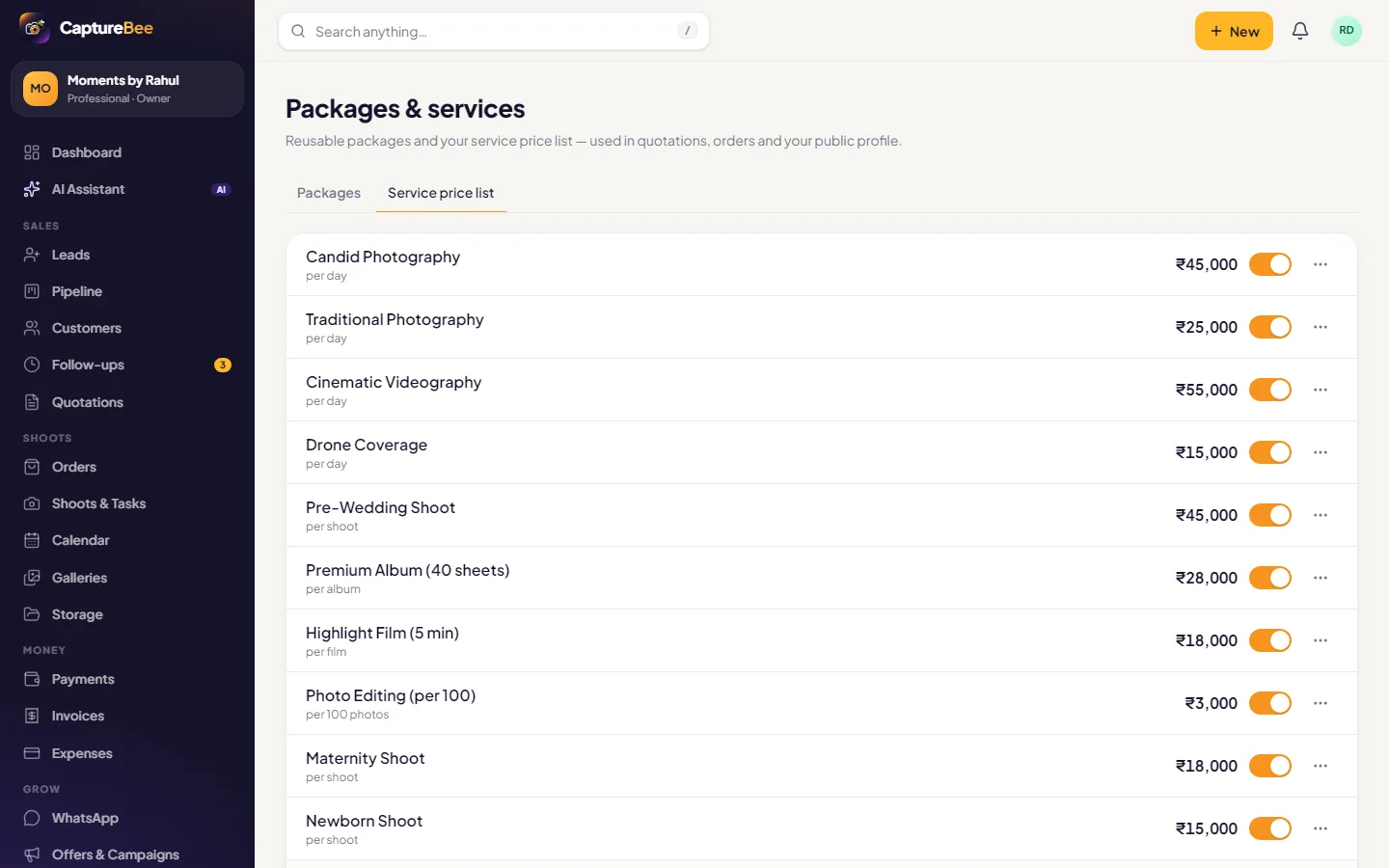
In CaptureBee these services appear as quick-add buttons when you build a quotation. Switch a service off when you no longer offer it, without deleting its history.
Upsells that clients actually want
Good upsells feel like help, not pressure. The ones that work best for photographers:
- Pre-wedding shoot with a wedding package
- Drone for outdoor functions and destination weddings
- Highlight film or reels for couples who live on Instagram
- Extra album for parents
- Same-day edits for receptions or corporate events
- Maternity and newborn shoots for past wedding clients (months later — see offers and campaigns)
Offer upsells on the quotation itself as optional lines, or in the follow-up: "Many couples add a 1-minute reel for ₹8,000 — want me to include it?"
Seasonal and weekday pricing
Wedding season dates sell themselves; weekday dates in the off-season do not. Consider:
- Peak-date pricing for the most auspicious dates in the season
- Off-season or weekday offers to fill quiet months — announced through a campaign to past clients and lost leads
- Early-booking discounts for couples who confirm months ahead
Keep these as clear, time-bound offers rather than permanent price cuts.
Should you show prices publicly?
There is no single right answer:
- Showing prices filters out clients who cannot afford you, saves time on enquiries that won't convert, and builds trust.
- Hiding prices starts more conversations and gives you room to tailor — but some couples will skip you rather than ask.
A common middle ground: show "starting from" prices for each package, or show prices for smaller shoots (birthday, maternity) and keep weddings on request.
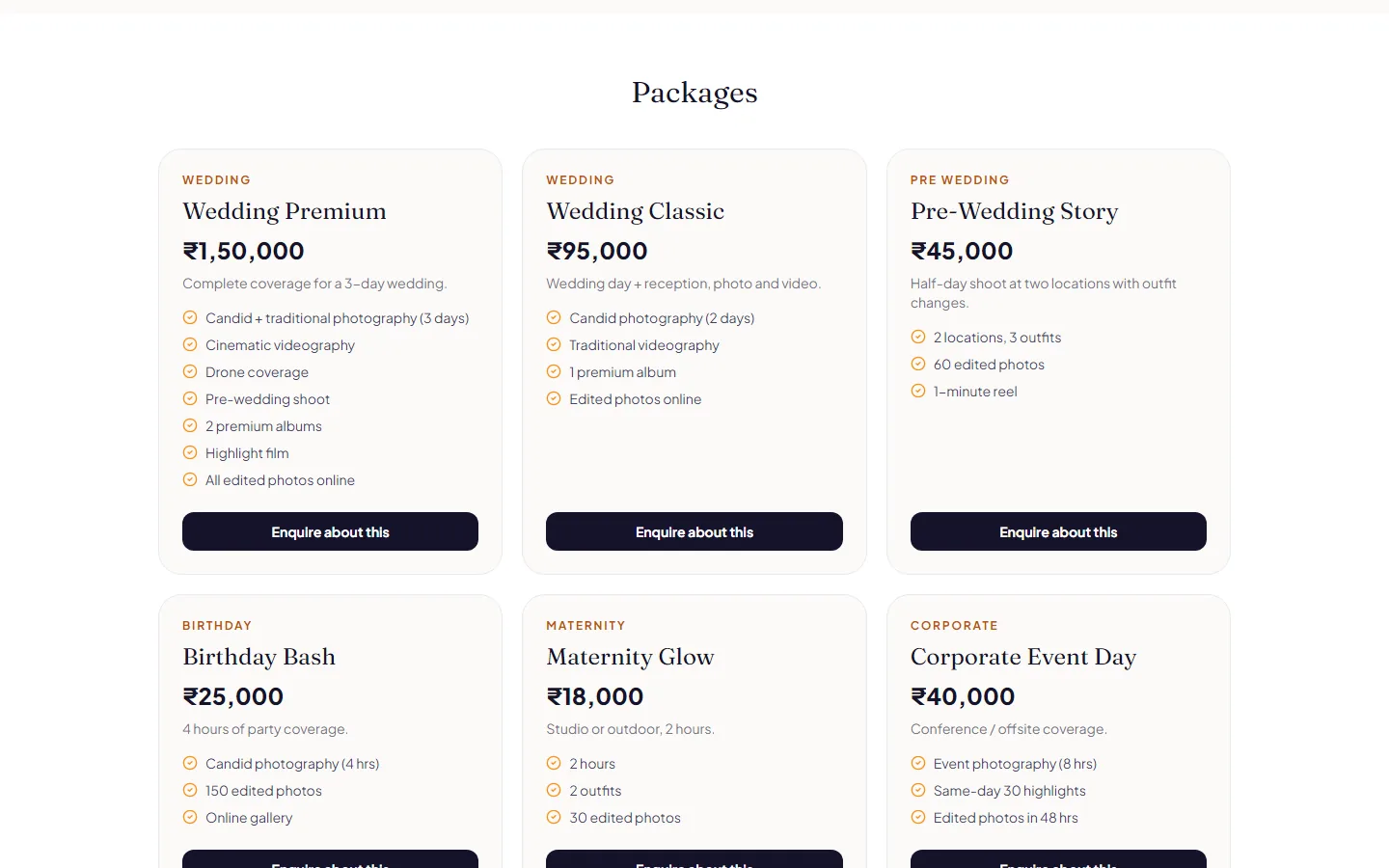
CaptureBee lets you choose. Your public profile shows your packages with an Enquire about this button on each, and Show package prices in Settings → Public profile switches prices on or off. Each package also has its own "show on public profile" setting.
Revisit prices with data, not gut feeling
Once a season, look at the numbers:
- Which packages sell most? If one package is 70% of bookings, it is either priced perfectly or too cheap.
- Average order value — is it rising as you add upsells?
- Lead conversion — if most enquiries go quiet after the quotation, look at the price and the presentation.
- Profit per event type — weddings may bring revenue, while maternity shoots bring margin.
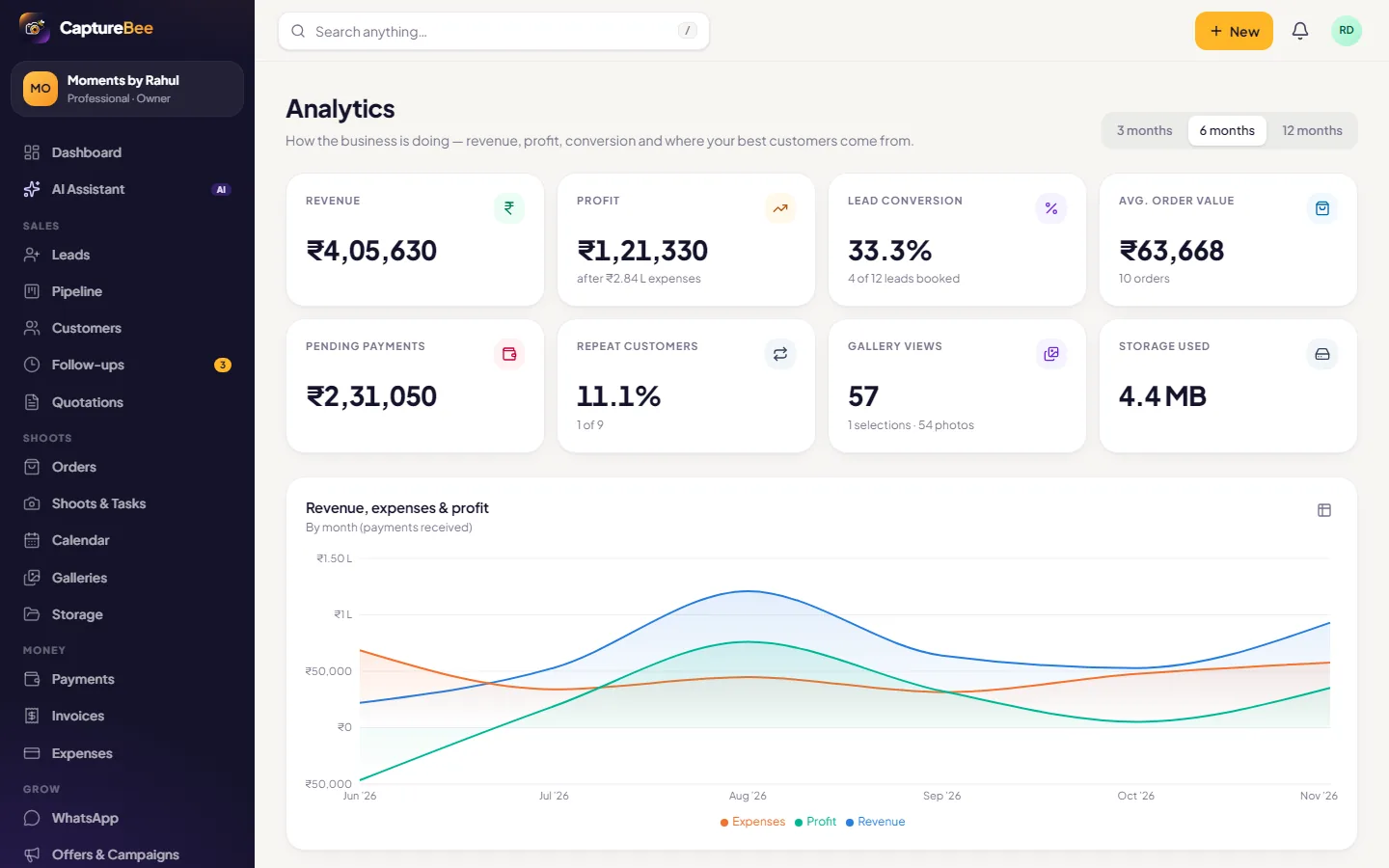
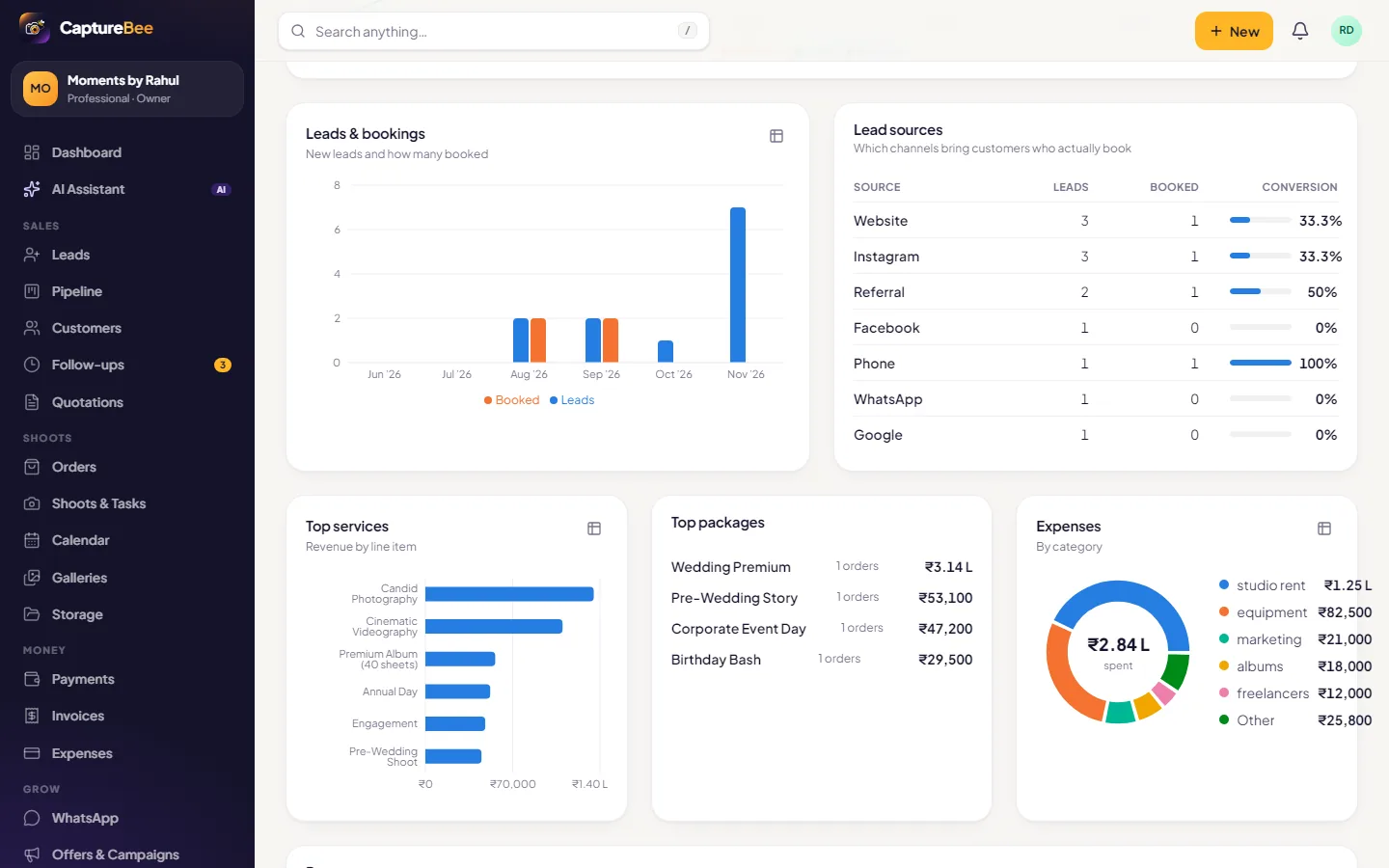
CaptureBee's analytics shows top packages and top services by revenue, average order value and conversion. See the analytics feature.
Setting up packages in CaptureBee
- Go to Packages & services.
- Under Service price list, add your individual services with a price and unit (per day, per shoot, per album, per 100 photos…).
- Under Packages, create each package: a name, category (Wedding, Pre-Wedding, Birthday, Maternity, Corporate…), price, a short description, the items it includes and the deliverables.
- Choose whether each package appears on your public profile.
- Duplicate a package to make a variation quickly; archive old packages instead of deleting them, so past quotations keep their history.
- Build a quotation: pick a package, quick-add services, adjust — done. The step-by-step is in wedding photography quotations clients accept online.
Naming and presenting packages
How a package looks matters almost as much as what's in it.
- Give packages names, not numbers. "Wedding Classic" and "Pre-Wedding Story" are easier to remember and talk about than "Package 2".
- Lead with the outcome. The first line of the description should say what the client gets: "Complete coverage for a 3-day wedding."
- List four to seven inclusions. Enough to show value, few enough to read on a phone.
- Put the most important item first. For weddings, that's usually the coverage (days, photographers); for pre-weddings, the locations and the reel.
- Use categories. Wedding, Pre-Wedding, Birthday, Maternity, Corporate — so clients (and your team) find the right packages quickly.
- Keep the order deliberate. Show the package you most want to sell in the middle or highlighted.
Pricing for different markets
Photography prices in India vary enormously between a metro and a smaller city, and between a ₹15 lakh wedding and a ₹2 crore one. A few principles help you price for your market:
Know your client, not just your city
A photographer in a tier-2 city who shoots large business-family weddings may charge more than a metro photographer who mostly shoots small weddings. Price for the clients you want, and make your portfolio, profile and reviews speak to them.
Destination weddings
For destination weddings — Goa, Udaipur, Jaipur, Kerala, abroad — price the coverage as usual and treat travel separately:
- Travel and stay for the team at actuals, or arranged by the family
- A per-day rate for travel days, since the team can't work elsewhere
- Possibly a destination supplement for long days and extra logistics
Write these in your terms so they appear on every quotation.
Peak versus off-season
Peak wedding dates sell out regardless; off-season dates need a reason. Rather than cutting your standard prices, create specific off-season offers — "weekday weddings in July get a free pre-wedding reel" — and send them as a campaign to leads and past clients.
Raising your prices without losing clients
Costs go up every year — gear, freelancers, albums, fuel. If your prices don't, your profit shrinks quietly. Raising prices is less scary with a plan:
- Look at the evidence. If your middle package sells out every peak season, or most couples accept your first quotation without negotiating, you're probably under-priced.
- Raise for new enquiries only. Honour every quotation already sent, and every client already booked.
- Raise in steps. 8–15% a season is easier for the market to absorb than one big jump.
- Add visible value. A slightly better album, a reel included, faster delivery — so the new price comes with a new reason.
- Watch conversion. If it drops sharply, adjust the presentation before you drop the price.
- Update everything at once. Packages, the service price list and your public profile, so every client sees the same prices.
In CaptureBee, change the prices on your packages and services; new quotations use the new prices, while existing quotations and orders keep what was agreed.
When a client wants something custom
Many clients want "Wedding Classic, but…". That's fine — packages are a starting point, not a cage. A few rules keep custom requests profitable:
- Start from the closest package so your pricing logic stays intact.
- Add and remove items at your service-list rates. Removing drone takes off the drone rate; adding a second album adds the album rate.
- Don't remove the things that make the package work. If the package exists because candid and traditional coverage go together, explain why.
- Name custom quotations clearly — "Rahul & Priya — Wedding (custom)" — so your team knows it differs from the standard package.
If the same custom request comes up again and again, it's a sign you need a new package.
Packages for portrait, newborn and product work
Not every photographer shoots weddings. The same principles work for other niches:
Newborn and maternity studios often sell sessions plus products: a session fee (₹12,000–20,000 for example) that includes a set number of edited photos, with prints, frames and albums as add-ons. Repeat business is natural — maternity, newborn, first birthday, family portraits — so tags and campaigns matter.
Product and e-commerce photographers usually price per image or per product with tiers by volume, plus extras like lifestyle shots, model fees and retouching. Use the service price list with a unit like "per image" or "per product", and packages for common bundles ("50 products, white background, 3 angles each").
Corporate photographers price by half day and full day, with same-day delivery, extra hours and usage rights as extras. Clients expect GST invoices and payment on invoice.
Portrait photographers often use simple tiers: a mini-session, a standard session and an extended session, with the number of looks and edited photos rising at each tier.
Albums: options and pricing
The album is the deliverable couples hold for decades — and one of the easiest places to lose margin. Get clear on what you offer:
- Size — common sizes include 12×36 inch spreads (12×18 per page) and smaller formats for parents' albums.
- Number of sheets — usually 20–40 for weddings; price extra sheets individually.
- Paper and binding — layflat, photo paper versus printed, matte or glossy.
- Cover — leather, fabric, acrylic or photo cover, often with an engraved name.
- Box — a presentation box adds a lot of perceived value for a modest cost.
Price albums from your real supplier cost plus your design time. A useful structure:
| Item | How to price it |
|---|---|
| Main album (e.g. 30 sheets) | Included in packages, at a cost you've checked |
| Extra sheets | A fixed price per sheet |
| Parents' albums | An add-on, usually smaller and simpler |
| Cover upgrades | A fixed extra per upgrade |
| Rush printing | An extra, if your lab offers it |
Write the number of sheets and the selection limit into the package, so the album and the photo selection match. See online photo selection.
Talking about price on a call
Many couples ask about price on the first call. How you present it matters as much as the number.
- Ask before you quote. Date, functions, venue, guest count, what they care about. You can't recommend a package without it.
- Recommend one package, with a reason: "For a two-day wedding with 400 guests, most couples choose Wedding Classic — two photographers, a cinematic film and a 30-sheet album."
- Then give the price, clearly and without apology.
- Mention the range: "If you'd like more, Premium adds drone and a pre-wedding shoot; if you'd like to keep it simpler, there's Essential."
- Explain the advance and what it does: "A 30% advance confirms the date for you."
- Follow up with the quotation link the same day, so they have it in writing.
Confident, clear pricing reassures couples that you're a professional — and it's far easier when your packages are already set up.
Pricing mistakes to avoid
- Copying a competitor's price list. Their costs, crew and style are not yours.
- Forgetting editing time. Shooting is often less than half the hours a booking takes.
- Too many packages. Choice paralysis kills decisions.
- Vague inclusions. "Full coverage" invites disputes. "8 hours, 2 photographers, 400+ edited photos" does not.
- Discounting the package instead of reshaping it. Offer the smaller package rather than cutting your best one.
- Never raising prices. Costs rise every year; your prices should too. Raise for new enquiries, honour quotes already sent.
- Not counting album and printing costs. They are easy to underestimate, especially for premium albums.
A one-page price sheet
Many couples ask for "your rates" before they're ready for a quotation. A one-page price sheet answers the question professionally — and keeps you from typing prices into chats. What to include:
- Your name, logo and one line about your style.
- Three to five packages per event type, each with a name, a "starting from" or exact price, and four to six inclusions.
- Popular add-ons with prices: extra hours, drone, reels, extra album sheets, parents' albums.
- Your advance and balance terms in one line.
- Travel policy for out-station events.
- What's not included — raw files, extra retouching — so expectations are clear from the start.
- How to book: your phone, WhatsApp and profile link.
Your public profile does the same job online: packages with prices (if you choose to show them), an Enquire button on each, and an enquiry form that creates a lead. Share the profile link instead of a PDF and every enquiry comes back to you as a lead with its source recorded. See reviews and your public profile.
Whatever you send, keep it consistent with your packages in CaptureBee — the price a couple sees on the sheet should be the price on their quotation.
Packages for smaller weddings
Not every wedding is five functions and 800 guests. Registered marriages followed by a dinner, intimate temple weddings and small destination weddings are increasingly common — and couples planning them often assume you're out of their range.
A small-wedding package can be a profitable entry point:
- Shorter coverage — 3–5 hours, one or two functions.
- One photographer, optionally with a videographer for a short film.
- Online gallery and a small photo book instead of a large album.
- A clear name — "Intimate Wedding" — so couples see it's designed for them.
These couples are often the ones who come back for anniversary shoots, maternity and family portraits — and who recommend you to friends with bigger weddings.
Quick checklist
- Three to five packages per event type, with names and clear inclusions
- Your middle package is the one you most want to sell
- Prices are checked against real costs, including your time
- A service price list covers add-ons with units
- Album options and extra sheets have fixed prices
- Travel and out-station terms are written down
- Packages on your public profile match your quotations
- Prices are reviewed every season with real numbers
Frequently asked questions
How much should I charge for wedding photography in India?
It depends heavily on your city, experience, crew and deliverables. Work out what a wedding costs you — crew, editing, albums, travel and your share of fixed costs — add your time and a margin, then check that the result makes sense against your local market.
How many photography packages should I offer?
Three to five per event type. Make the middle one your best-value, most-promoted package.
Should packages include an album?
For weddings, usually yes — couples expect one, and it is a meaningful deliverable. Offer extra albums (for parents) as an add-on.
Can I change a package for one client?
Yes. In CaptureBee, pick the package on the quotation and add, remove or change items for that client. The package itself stays unchanged.
What's the difference between a package and a service?
A package is a bundle with one price (Wedding Classic). A service is a single item with a unit price (candid photography per day). Packages are for most clients; services are for add-ons and custom quotes.
Should I show prices on my website?
Showing at least "starting from" prices filters enquiries and builds trust. CaptureBee lets you show or hide package prices on your public profile.
Price with confidence
Good pricing is not a guess and not a copy. It is a short list of clear packages, priced from real costs, with add-ons for everything else — reviewed each season with real numbers.
Set up your packages once and every quotation after that takes a minute. Start a free CaptureBee trial, add your packages and services, and send your next quotation from them. Then read about collecting advances and tracking dues.